Year 4
Welcome to Year 4!
Meet the Year 4 team
Class Teachers
- Mr B Poole - Year 3 and 4 Phase Leader and Penguins Class Teacher
- Mrs H Downing and Mrs C Tudgay - Eagles Class Teachers
- Miss T Begum - Puffins Class Teacher
LSPs (Our LSPs work across Year 3 and Year 4)
- Mrs K Gordon
- Mrs L Gibbons
- Miss S Jones
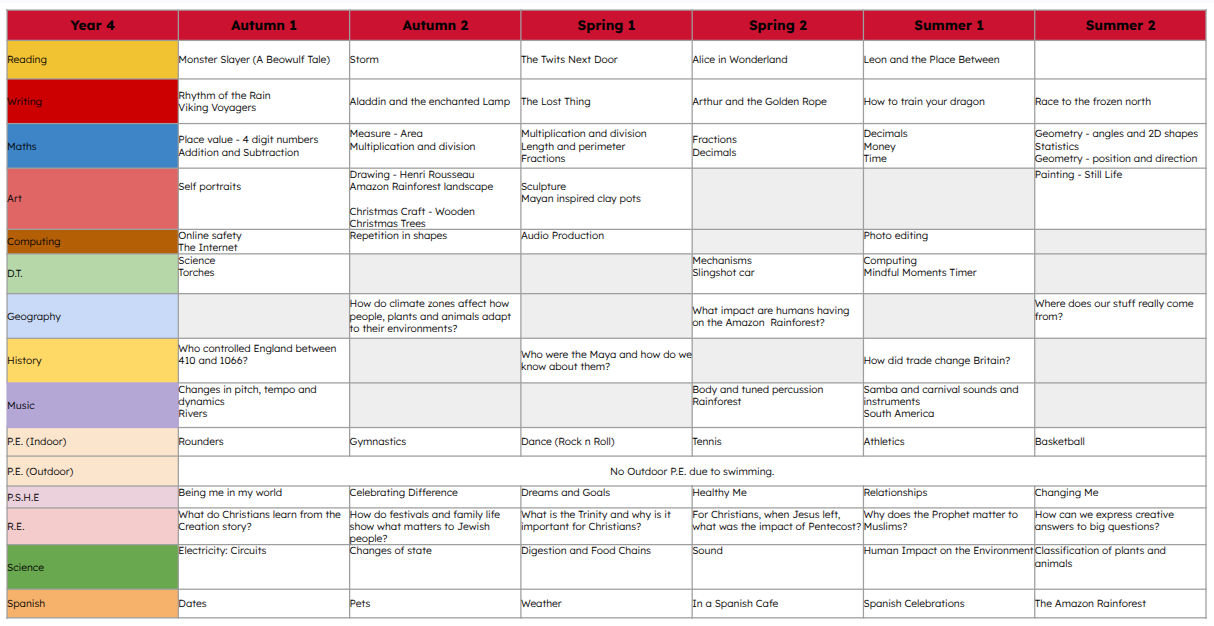
Our Learning Overview
Reading at Home
Reading is at the heart of learning at Rowley Hall. We want every child to become a confident, fluent reader who enjoys books and can use their reading skills across the curriculum.
Children develop their reading through daily phonics or whole-class reading sessions, alongside opportunities to enjoy a wide range of texts. As children become more fluent, they learn to retrieve information, make inferences, predict what might happen next and discuss what they have read.
Reading at home is an essential part of this journey. We encourage families to read regularly with their children, talk about books and record home reading in their child's reading diary. Teachers monitor these diaries and assess children's reading progress in school.
Reading books are carefully matched to children's developing skills. Progression through book bands is based not simply on the number of books read, but on fluency, understanding and the ability to apply reading skills independently.
Reading in school
In Year 4, children build on their reading fluency and develop a deeper understanding of increasingly challenging texts. Through whole-class reading, they learn to make inferences, summarise key ideas, explore vocabulary and explain how authors use language to engage readers.
Reading at home
Please encourage your child to read at least three times a week and record this in their reading diary. Although children are becoming more independent, listening to them read and discussing their books remains important. Ask questions such as "Why do you think the character acted that way?" or "Which words helped you work that out?"
Multiplication Tables Check (MTC)
In June, all Year 4 children take part in the statutory Multiplication Tables Check (MTC). This is an online assessment designed to check how fluently children can recall their times tables up to 12 × 12. Children answer 25 multiplication questions, with six seconds to answer each question and a three-second pause between questions. The check takes less than five minutes to complete and is carried out in a familiar, supportive environment. The MTC helps teachers identify children who may need additional support with their multiplication facts. There is no pass or fail mark, and parents will be informed of their child's results.
How Can You Help at Home?
Quick, regular practice is the best way to help your child develop confidence and fluency with their times tables. Children should aim to recall multiplication facts accurately and automatically, without needing to count or work out each answer. We encourage children to use Times Tables Rock Stars (TTRS) at home to practise their multiplication facts in a fun and engaging way. Just five minutes of regular practice can make a real difference! The Department for Education provides further information about the Multiplication Tables Check and how you can support your child - you can find this in our 'Useful Links' section at the bottom of this page.
Swimming
In Year 4, all children have the opportunity to take part in swimming lessons for one term as part of our PE curriculum. Swimming is an important life skill, and these lessons help children develop their confidence, water safety awareness and swimming ability. Lessons are delivered by qualified swimming instructors, with activities adapted to suit children's different levels of confidence and experience. Children learn and practise a range of swimming skills, including different strokes, safe entry and exit from the water, and how to stay safe in and around water.
In line with the National Curriculum, we aim for all children to be able to swim competently, confidently and proficiently over a distance of at least 25 metres, use a range of strokes effectively and perform safe self-rescue in different water-based situations. Further information about swimming arrangements, including what children need to bring, will be shared with parents before lessons begin.